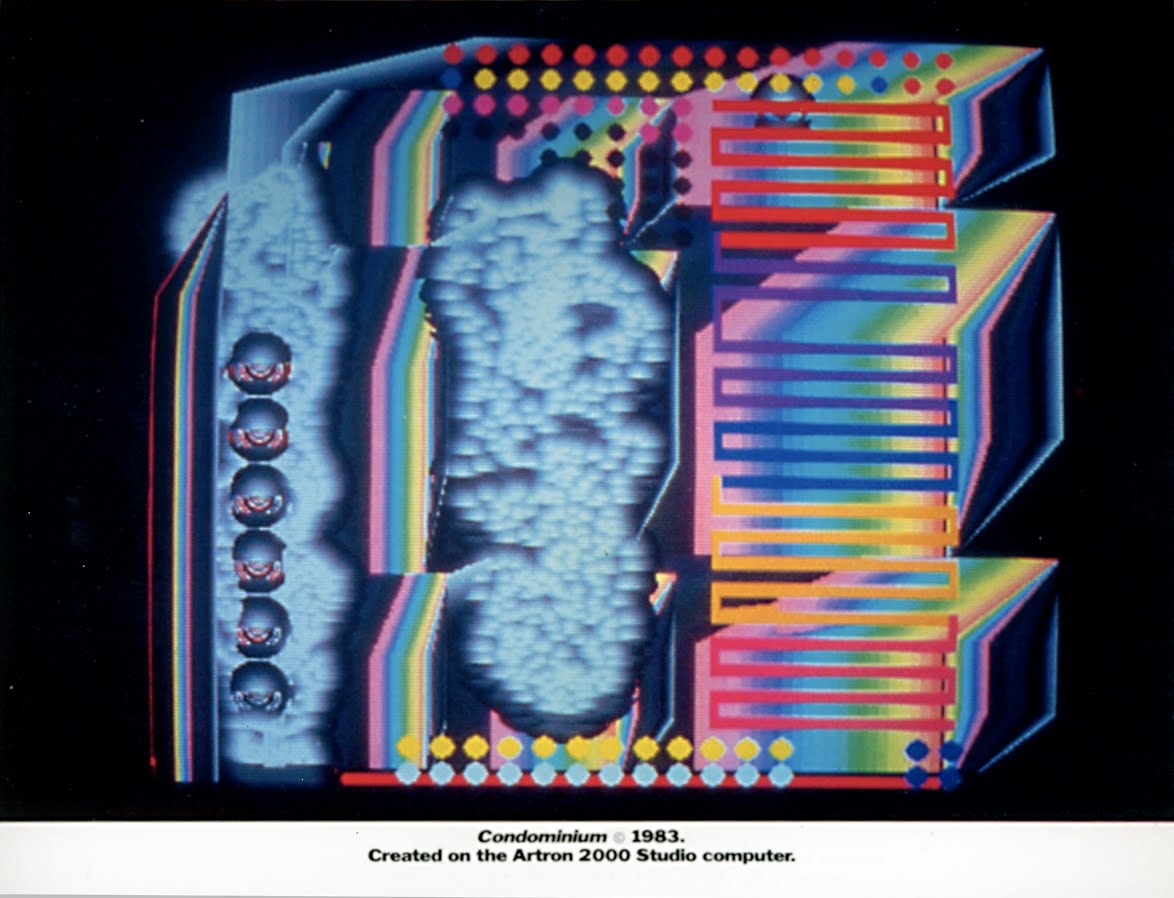
6.1.11

NEON SUNLIGHT

Stills from a work in progress.


3.1.11

REACHING FOR AQUARIUS

Syd Mead is a visual futurist and concept artist. He is best known for his designs for science-fiction films such as Blade Runner, Aliens, and Tron. Of his work, Mead was once moved to comment: "I've called science fiction 'reality ahead of schedule." -Wikipedia

Illustrations and commentary by Syd Mead.
Source: Automobile Quarterly, vol 18 no.1, 1975

TRACK ONE
In the early evening guests arrive in gyro gondolas with their cyborg pets and android attendants. The residents have programmed the illusion pool, filled the foyer with halographic crystal lattices, and provided elegant pneumatic enclosures for the occasion.


TRACK TWO
Standard public lease system vehicles enter a mobile lobby at left, containing shops, lounges and information centers, loading for the half mile transit to megastructure in background. Corporate and privately leased vehicles in middle foreground, fitted to specific use, await departure. Two personal enclosures float over the parking lane in foreground, while late afternoon strollers walk past an illusion cluster at far right: large sculpture overlooking illusion plaza is monument to first extra-terrestrial visitors.


TRACK THREE
An elegant robot serves party guests in vaporspheres out on the terrace, while conversational groups inside enjoy the atmosphere of halogram wall display, the sumptuous buffet, and pneumatic banquette seating. A couple are juste leaving, far left, after programming a travel enclosure from the special matrix wall.


2.1.11

SARA LUDY


I rarely post contemporary works on this blog, since I'm usually more inspired by older works. But here is a contemporary artist who's work slowly grew on me, to the point that I consider her as one of my favorite. Her work often takes place in familiar spaces where a surreal atmosphere emerges; there's a striking tension between the banal and the fantastic.
Sara Ludy's work can be found here, here and here.

27.12.10

FROM HERE I CAME TO PLANET EARTH


LAURENCE M. GARTEL
The birth of Gartel's career as an artist can be pinpointed to 1976 at the Media Study in Buffalo, a center for experimental video. That year represents a watershed in his development as he worked alongside Nam June Paik, the father of video art. At that time, Gartel set his goal to make stills from video - the opposite of what was being done at the center - and the step to the computer screen was swift.
His processes vary but he usually starts with the camera image. Basically he uses a special printer with a built-in scanner, inserts photos into the computer system, merges them, photographs the new multilayered video images, and then enlarges them, sometimes to forty by fifty inches. And that is only the beginning. (...) Every new device means more fun for Laurence.

Laurence M. Gartel: A Cybernetic Romance, 1989


19.12.10

DEAN WINKLER

This episode from the first season of the Video Artist (1983?) featured Tom DeWitt, Vibeke Sorensen and myself (Dean Winkler) discussing two of our pieces, Tempest and Voyage.


Abstract video art created in 1981. Video by Dean Winkler, Tom DeWitt, Vibeke Sorensen and Robert Lund. Music by Tom DeWitt and Vibeke Sorensen.


Abstract video art created in 1986 for Expo '86 in Vancouver, BC. Video by John Sanborn and Dean Winkler. Music by Daniel Lentz.

17.12.10

THE LAST OF THE EPIC VIDEOS

I made it! I succeeded in making one video a week for a whole year!
52-Pick-Up is a project conceived and coordinated by Dayna McLeod: "52 Pick-Up is a series of videos made by anyone who is up for the challenge of making one video a week for 52 weeks straight. It is a video production challenge. Equivalent to drawing a sketch-a day or writing a page-a-day, it's an exercise in endurance to get the juices flowing with a quick deadline that can be used as an excuse for both brilliance and failure."

When I started this project, I thought that I could miss one or two weeks occasionnally... But I caught myself being really engaged in the process, not wanting to miss one week even if it meant posting some ugly weird stuff.
After a year, I can say that it radically transformed my philosophy about producing work, and about what I value in terms of video making. Now, I feel more strongly about the process than about anything else. The gems that come out of this process are rare and not to be expected. Making videos is all about work. The magic occurs once in a while, in between two ugly videos...

Most of the videos on that 52 Pick-Up page are sketches and experimentations that I've integrated later in more accomplished works. I tried to create new and different approaches with each video, finding my own "home-made" way of creating visual effects. Here are some videos that never ended up on my Vimeo or anywhere else, but that I am still very fond of.

WEEK 4
La mer électronique---music by Laurie Spiegel


WEEK 51

16.12.10

LARRY CUBA


Larry Cuba is widely recognized as a pioneer in the use of computers in animation art. Producing his first computer animation in 1974, Cuba was at the forefront of the computer-animation artists considered the "second generation" --- those who directly followed the visionaries of the sixties: John Whitney, Sr., Stan Vanderbeek and Lillian Schwartz.

Larry Cuba interviewed by Gene Youngblood, in 1986 (excerpt)
"Someone once asked what I mean by the term "experimental film." What makes them experimental? I said because they’re not previsualized. They're the result of experiments and dialog with the medium. And he said, 'Well, all art is like that, that's what art is." I said all art is like that but all film is not. We're much more used to films being preconceived, both in content and execution. Even many people with whom I share the same intent will listen to a piece of music, come up with images, storyboard them and animate them . So that by the time they get to the production stage the result is almost a foregone conclusion.

That's much less of a dialog than my approach and in that sense it's not as experimental. Also there's the danger that the music is carrying the piece: take away the sound and there's not much left. In my work, the visuals come first. I'm trying to discover what works visually, so I never start with music. That would be starting with a composition that already exists, and composition is the problem. I don't have an image of the final film or even any of the scenes before I start programming. I only have basic structural ideas that come from algebra, or from the nature of the [computer] drawing process, or from the hierarchical structure of the items in the scene and how they will dance---the choreographic movements from a mathematical point of view.
"

Excerpt of Calculated Movements (1985), 16mm, B/W


In the 1970s the computer graphics for the first Star Wars film (1977) was created by Larry Cuba at the Electronic Visualization Laboratory (EVL) (at the time known as the Circle Graphics Habitat) at the University of Illinois at Chicago.


For the rest of the interview:
http://prehysteries.blogspot.com/2008/07/larry-cuba-interviewed-by-gene.html

12.12.10

9.12.10

4.12.10

SHIMMER, 1985

A live performance documentation by Ed Tannenbaum.
The soundtrack is by Maggi Payne.

27.11.10

VIRTUAL GALLERY

By Lillian Schwartz. From her book The Computer Artist's Handbook, 1992


(Accepted version of the MOMA poster, 1984)


(Dance of Matisse and Modigliani's Nude Observed by Me, 1985)


(MOMA Gallery 1, 1983)


(MOMA project images, 1982-83)

22.11.10

A CYBERNETIC ROMANCE

"I discovered the power of single graphic images while working with my longer video pieces. Stopping the action reveals frames far more beautiful still than in motion." - Nam June Paik, A Cybernetic Romance, 1989

Pour une raison que je ne peux encore expliquer, je documente presque frénétiquement toutes mes expérimentations vidéos, même celles qui ne prendront jamais une forme définie. Il me semble que les mouvements aléatoires des images créent des possibilités de compositions impossibles à prévoir, et qui sont souvent plus intéressantes à regarder lorsqu'elles sont figées. J'ai donc commencé un blog, une sorte de banque d'images tirées de mes vidéos, qui marque ces étapes vers la réalisation d'un résultat final ou non. On peut y jeter un coup d'oeil ici.

J'ai été confirmée dans mes impulsions lorsque je suis tombée sur cette citation de Nam June Paik tirée du livre A Cybernetic Romance, 1989, sur le blog PAINTED, ETC. (J'ai aussi commandé le livre, qui en plus d'un texte d'introduction de Nam June Paik, semble contenir des images surprenantes de Laurence M. Gartel.)