28.9.11

REACTION-DIFFUSION /// EVA SCHINDLING

Computational reaction-diffusion systems mimic chemical pattern formation in nature. A mixture of two or more chemicals that react with each other and have different diffusion rates forms macroscopic patterns in time and space of chemical concentration. The chemical mixture stays in a continual flux and therefore far from equilibrium.

Alan Turing was the first one who proposed reaction-diffusion systems as a theoretical idea to explain biological morphogenesis. It demonstrates how breaking and pattern formation can arise out of a homogeneous, uniform state.

The Belousov-Zhabotinsky reaction is a special non-equilibrium system that works as a chemical oscillator as it cycles through its different states in autocatalytic fashion. If unmixed the diffusing chemicals spread and cause spirals to emerge and grow.

Also, give a look at her inspiring website filled with inspirations, projects, research, links etc. http://www.evsc.net


24.9.11

ACTIVATED MEMORY

Stills taken from a serie of videos in progress that I have entitled "Activated Memory". I'm using photographs that I take of Montreal parcs and houses and I animate them in order to create enclosed gardens and artificial environments.


18.9.11

VOL LIBRE /// LOREN CARPENTER

I made this film in 1979-80 to accompany a SIGGRAPH paper on how to synthesize fractal geometry with a computer. It is the world's first fractal movie. It utilizes 8-10 different fractal generating algorithms. I used an antialiased version of this software to create the fractal planet in the Genesis Sequence of Star Trek 2, the Wrath of Khan. These frames were computed on a VAX-11/780 at about 20-40 minutes each.

7.9.11

AGE MAZE /// Le Révélateur

Video for Le Révélateur

Age Maze along with Bleu Nuit and Mirages will be released on DVD this October by the San Francisco label Root Strata.

24.8.11

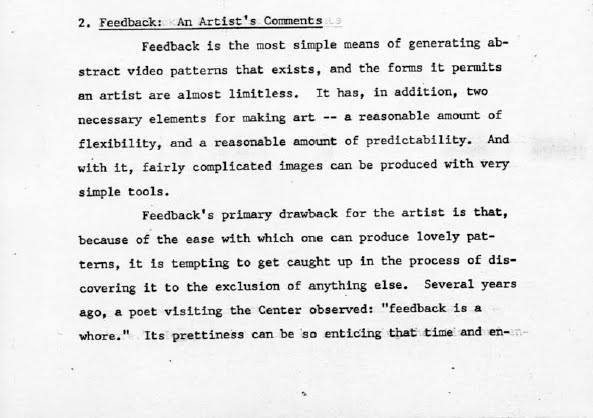
VIDEO FEEDBACK - WILLIAM GWIN

Excerpt from:
Gwin, William
.
Video Feedback: How to Make it; An Artist's Comments on its Use; A System Approach
. San Francisco, CA: National Center for Experiments in Television at KQED, undated.


23.8.11

WALTER VERDIN

I keep coming back on this video as an inspiration...
Check out also A melody by Walter Verdin on The Sound of Eye


15.8.11

ARTMATIQUE - ROBERT CAHEN - 1981

Cette œuvre faite de glissements de matières et de couleurs est conçue pour retenir le regard. Elle montre la forme suggestive de certains mouvements en retenant comme en écho l'empreinte de la trajectoire des images les plus signifiantes. Le système informatique utilisé, le S.M.C., a été mis au point par Jean-François Colonna au Lactame, l'un des laboratoires de l'Ecole Polytechnique : il permet de figer une image, de la numériser (en 1980 c'est une première et une prouesse technologique) et de la coloriser en direct. Le programme de traitement des images a été choisi par Dominique Belloir. 1981 / U Matic / Couleur / 4’ 15

More videos by Robert Cahen here

11.8.11

LE MESSAGE SIDÉRAL - HERVÉ NISIC - 1983

Les images qui vous sont présentées ont été recues par la station astronomique de Lançay. Elles ont été tenues secrètes à ce jour... 10'22

http://grandcanal.free.fr/


1.8.11

STATION BALNÉAIRE /// VARIATION I

Images of the Almalfi Coast have been transformed by video feedback. The rigid transitions, inspired by early computer art, contrast with the aleatory movements of the electronic light.

Music by Roger Tellier-Craig


28.7.11

Il Labirinto di Cristallo

bubblebyte.org is pleased to present Il Labirinto di Cristallo, a collective exhibition by diverse International practitioners working around the themes of Oceano, Futuro, Industriale and Azteca.

The show, inspired by the early 1990s British TV program “The Crystal Maze”, is conceived as a journey set around different areas, visions and artistic approaches, stressing and stretching visual possibilities in a playful and kaleidoscope mode that flirts with space and time displacement.

The diversity of vision and artistic approach allows discovery and experimentation, constantly crossing the line between imagination and reality, virtual and factual, abstract and actual, leading visitors throughout a multilayered and unexpected random wandering.

http://bubblebyte.org/


21.7.11

LA DIMENSION PROCHAINE

Stills from video experiments made using vintage postcards bought in Positano.


10.7.11

COMPUTER GRAPHICS - COMPUTER ART

Herbert W. Franke, 1971 (Preface to the first edition):

The works from computers nowadays covered by the term computer art are in my opinion among the most remarkable products of our time:
-not because they surpass, or even approach, the beauty of traditional forms of art, but because they place established ideas of beauty and art in question;
-not because they are intrinsically satisfactory or even finished, but because their very unfinished form indicates the great potential for future development;
-not because they resolve problems, but because they raise and expose them.

Herbert W. Franke, Computer Graphics - Computer Art, Second, Revised and enlarged Springer-Verlag Berlin Heidelberg, 1985


7.7.11

STATIONS BALNÉAIRES

Over the last few months, I have been working intensively on the footage I got from Positano and Capri. Out of this footage, I made an 8 minute video called Station Balnéaire for a show at the Ghost Gallery in Seattle, curated by Christian Petersen (including the work of Sara Ludy and Nicolas Sassoon among others). More info HERE. I also produced a series of stills taken from the video which will be posted soon on the site of their online magazine I Want You. It's worth taking a look at their website, there are some really amazing images. (Check out Stellar Om Source)

I am also working on a live video projection that will take place at the Montreal Gallery Espace Projet organised by Le Phosphène Ciné-club. Roger Tellier-Craig will accompany my images with his great electronic music and it will be very different from what we usually do with Le Révélateur. This will happen next Wednesday, July 13. Here are various stills taken from my experiments with these inspiring landscapes.


1.7.11

BERNARD DEMIAUX

Si le cinéma apporte le mouvement, si la vidéo le feed-back, on peut dire que l'ordinateur apporte l'intéractivité et notamment la manipulation de symboles. Il faut utiliser chaque outil selon sa spécificité.

Nous travaillons surtout à partir d'une image synthétique que nous créons directement dans la mémoire de l'ordinateur qui permet, à partir de calculs complexes, de donner des règles de composition de musiques ou d'images.

Ensuite, par algorithmes adéquats, c'est l'ordinateur qui pourra choisir les images; l'artiste étant en position de réception, d'écoute, pourra déterminer ou laisser émerger les images qui correspondront le plus à son idée de création.

(extrait de la conférence faite à Imagina à Monaco en 1982 pour le Groupe Module Digital Art.)

Bernard Demiaux's website - click on the link to download the video

Feu d'artifice dans la constellation du signe - Paris 1978


Fugue en bleu pour Siloé - Paris 1979


Album de famille - Imagina Monaco - 1982